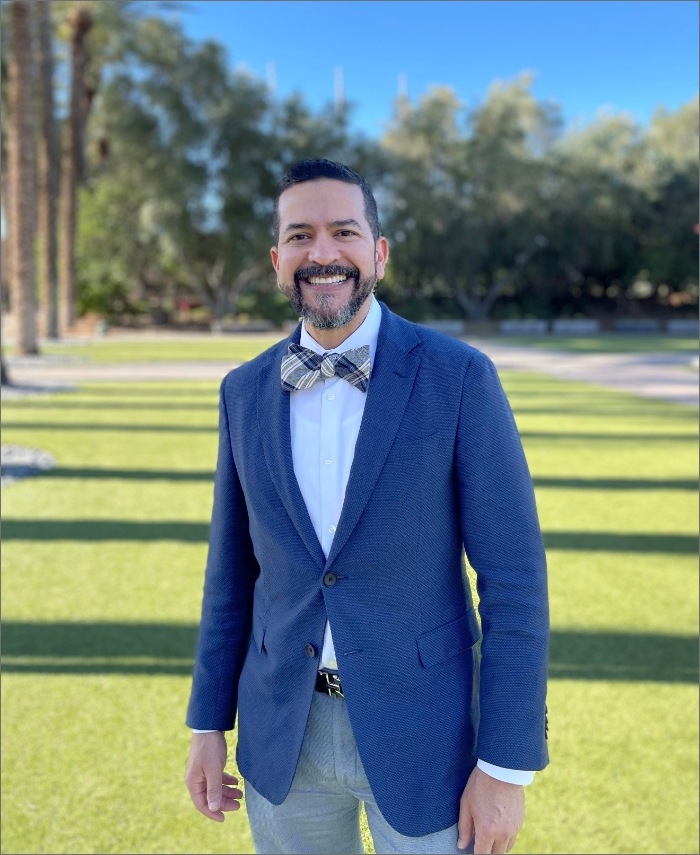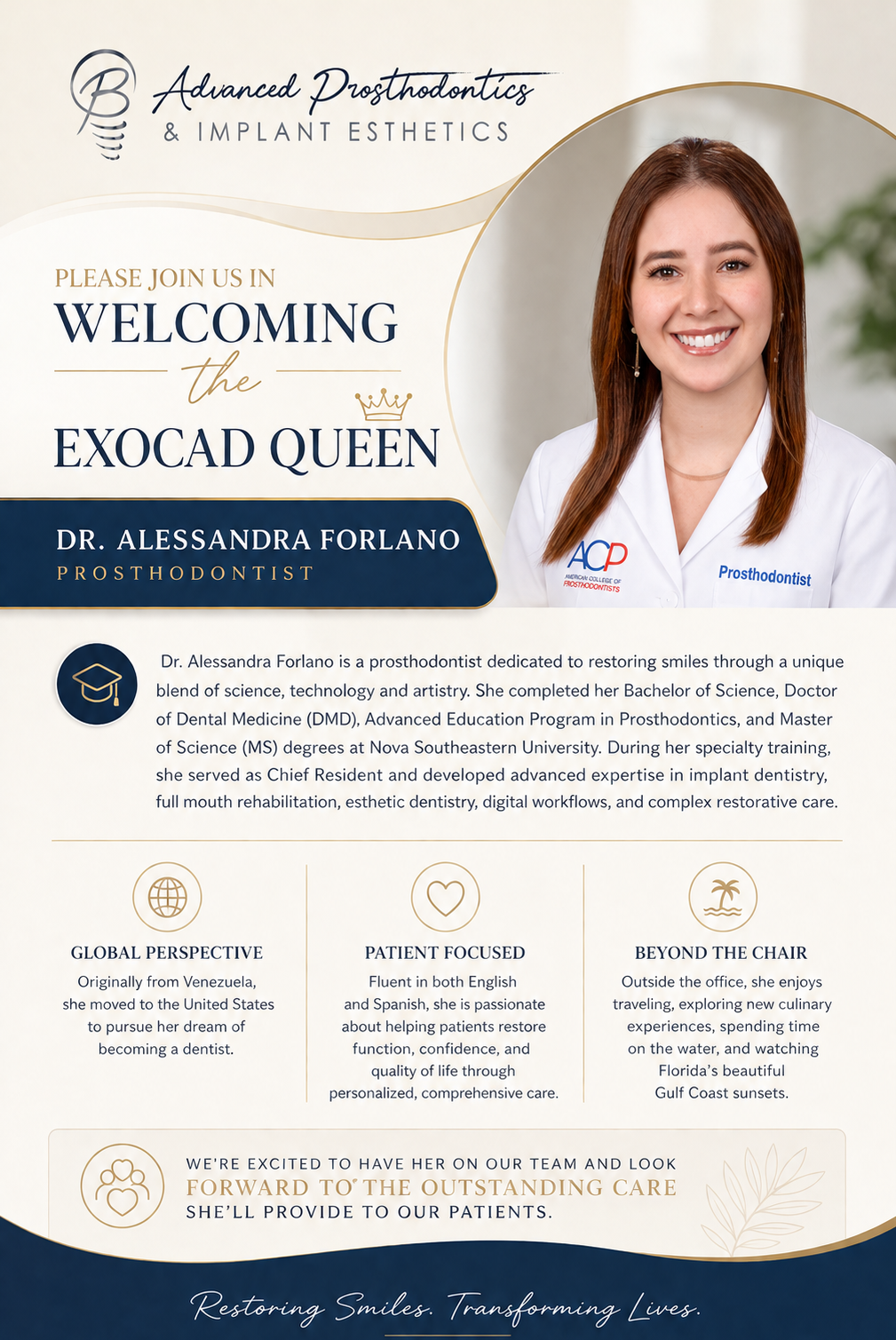
At Advanced Prosthodontics and Implants Esthetics in Naples, FL, this kind of interdisciplinary care is built into how we think about treatment. Our prosthodontists, Dr. Randold Binns and Dr. Eugenio Aquino, bring decades of combined training in both the surgical and restorative dimensions of implant therapy, giving patients access to a uniquely integrated level of care.
What Does Each Specialist Contribute?
The division of responsibility in a complex implant case is not random. It follows a clear logic: the oral surgeon focuses on the surgical environment, and the prosthodontist focuses on the final restoration. But in a well-coordinated case, those two goals are developed simultaneously rather than sequentially.
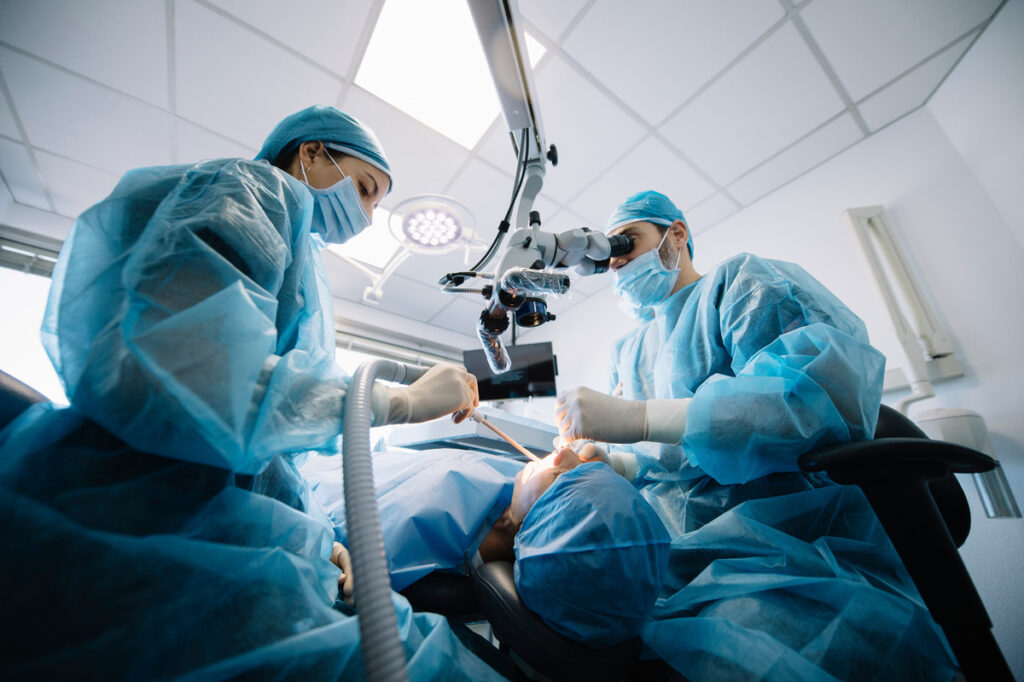
An oral surgeon handles implant placement, extractions, bone grafting, sinus lifts, and other procedures that prepare or modify the jaw for implant integration. A prosthodontist is responsible for designing the final prosthesis, choosing materials, planning the bite, and ensuring that the restoration functions and looks the way it should for the long term. According to a scoping review published in the National Library of Medicine, the collaboration between oral and maxillofacial surgeons and prosthodontists represents more than a sequential handover of steps. It is an integrated planning and execution process in which the desired prosthetic outcome fundamentally guides the surgical approach.
That distinction matters enormously in complex cases. When implants are placed without prosthetic guidance, the result may be functional but fall short aesthetically or create long-term maintenance challenges. The reverse is equally true: a beautifully designed prosthesis can fail entirely if the surgical foundation was not planned with the final result in mind.
When Interdisciplinary Care Becomes Necessary
Not every implant case requires multiple specialists. A straightforward single-tooth implant in a patient with healthy bone and good anatomy can often be managed efficiently within a single practice. However, several situations call for closer coordination between an oral surgeon and a prosthodontist.
Some of the most common scenarios include:
- Significant bone loss: When a patient has experienced bone resorption, a surgeon may need to perform a graft before implant placement is possible, with the prosthodontist informing how much volume is needed to support the planned restoration.
- Full-arch reconstruction: Procedures like All-on-4 involve placing multiple implants to support an entire arch of teeth, requiring precise angulation and spacing that can only be determined with the final prosthesis already designed.
- Oncologic or trauma cases: Patients who have undergone jaw surgery, radiation, or facial trauma often need coordinated rehabilitation that accounts for structural changes to the bone and soft tissue.
- Implant-supported dentures: Converting a removable denture to a fixed or implant-retained solution requires matching the implant positions to an existing or planned prosthetic design.
When full mouth restoration is the goal, every detail of the surgical plan is informed by what the final smile needs to look like and how it needs to function.
The Role of Technology in Coordinated Planning
Modern digital tools have transformed how prosthodontists and oral surgeons collaborate. What once required multiple rounds of impressions, models, and manual adjustments can now be accomplished through digital scanning, cone-beam CT imaging, and virtual treatment planning software. These tools allow both providers to visualize the final outcome in three dimensions before any procedure begins.
Surgical guides derived from digital planning are one of the most significant advances in this area. A guide is fabricated based on the prosthodontist’s restoration design and is used during surgery to ensure each implant is placed at precisely the right angle, depth, and position. This removes a significant amount of variability from the surgical phase and leads to more predictable prosthetic results. Dr. Aquino has built his practice around integrating these technologies, and that commitment directly benefits patients who require complex, multi-stage implant work.
Bone grafting procedures are another area where digital planning plays a key role. By modeling the amount and location of bone augmentation needed before surgery, the surgical and restorative teams can align on exactly what the jaw needs to support the planned implants without over-treating or under-building the site.
What Patients Can Expect from a Coordinated Case
Patients entering a complex implant case often feel uncertain about how many providers they will see, how long treatment will take, and how everything connects. A well-run interdisciplinary case should feel seamless from the patient’s perspective, with a clear sequence of steps, consistent communication between providers, and a single shared vision for the end result.
At Advanced Prosthodontics and Implants Esthetics, the restorative plan is developed before the surgical phase begins. This means patients are not navigating a patchwork of uncoordinated opinions. The treatment timeline is mapped out, the prosthetic goals are defined, and the surgical steps are sequenced accordingly. Patients also have access to flexible payment plans through CareCredit, Cherry, and Proceed Finance, making it easier to move forward with multi-stage treatment without financial uncertainty.
Trust Your Complex Case to Advanced Prosthodontics and Implants Esthetics
Dr. Binns, a surgical prosthodontist with advanced training at Nova Southeastern University School of Dental Medicine and the University of Illinois at Chicago, brings a rare combination of surgical knowledge and restorative precision to every complex case. Dr. Aquino, a maxillofacial prosthodontist and oral oncologist trained at UCLA School of Dentistry and the Michael E. DeBakey VA Medical Center, adds a depth of experience in rehabilitation cases involving structural complexity and digital workflows. Together, their backgrounds reflect exactly the kind of interdisciplinary thinking that leads to lasting implant outcomes. Our practice has served Naples and Southwest Florida for over 40 years, and we welcome patients from Bonita Springs, Fort Myers, Estero, Cape Coral, and Marco Island.
If you are facing a complex dental situation and want to understand what a coordinated treatment plan would look like for you, we encourage you to contact our office to schedule a consultation.